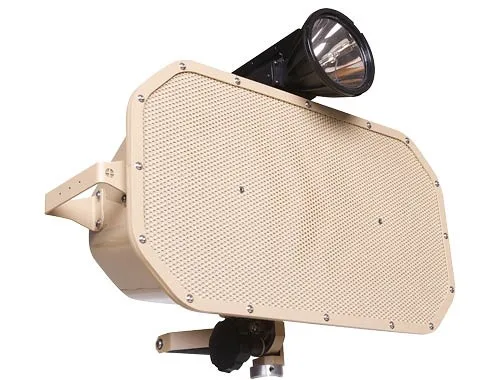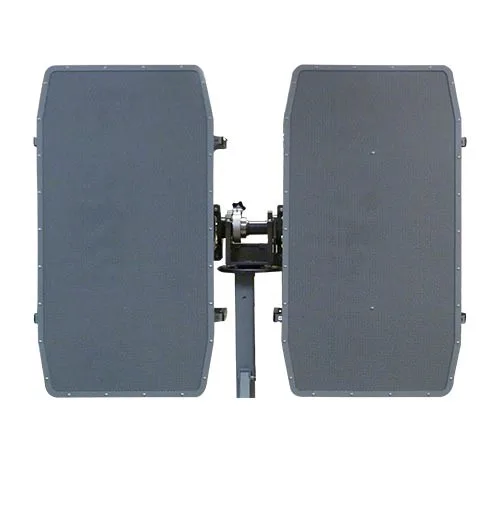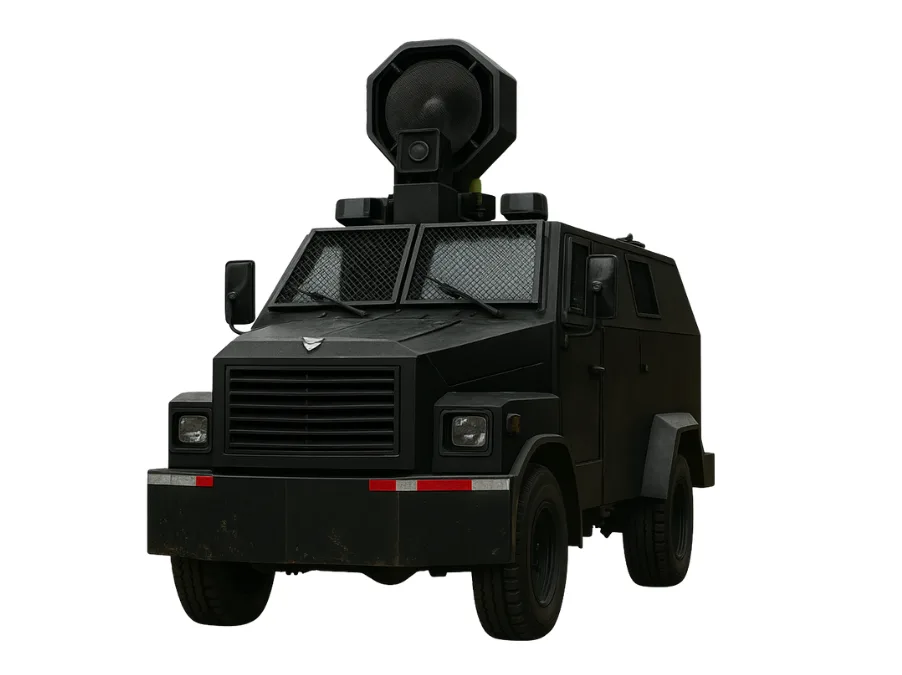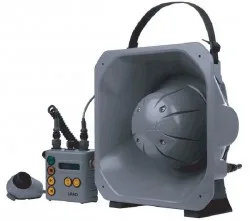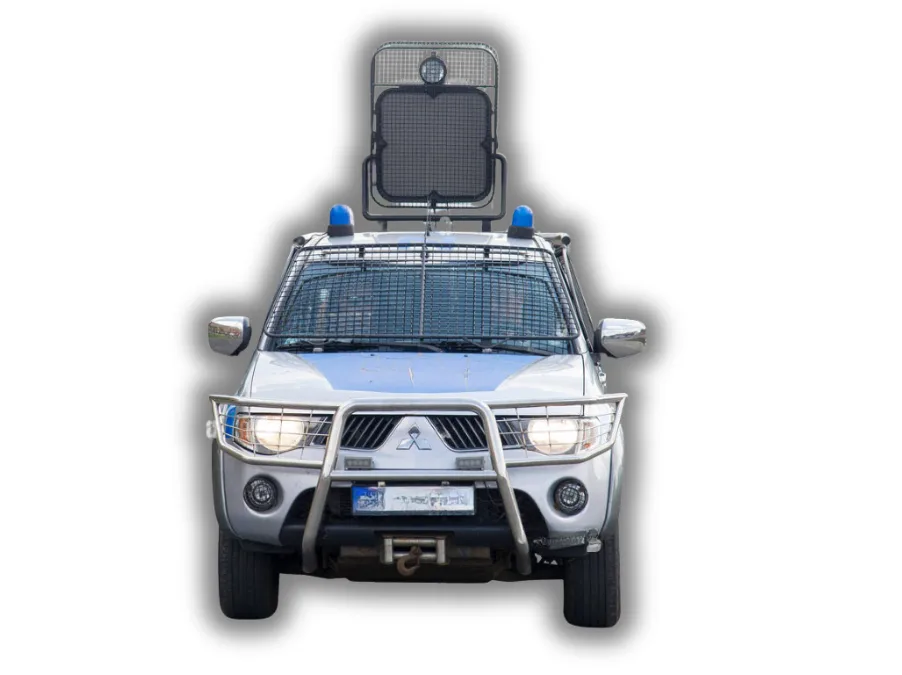
ACOUSTIC WEAPONS (LRAD)
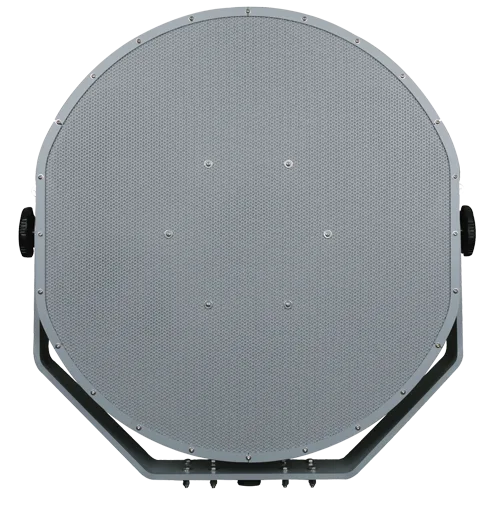
Long-range acoustic weapons, known as LRADs, use highly directional sound emissions to generate an immediate impact on auditory perception and balance. Their operation is based on arrays of piezoelectric transducers that concentrate acoustic energy into a narrow beam, enabling messages to be transmitted over long distances or high-intensity tones to be emitted, designed to disrupt the target’s capacity for orientation.
The precision of these systems depends on parameters such as the dominant frequency, the sound pressure level (dB SPL), the beam angle, and the distance to the target.
This architecture makes it possible to project sound with far greater power than a conventional loudspeaker, maintaining minimal dispersion and detailed control over the direction of the acoustic pulse.
Exploring this category provides insight into how wave engineering, the concentration of the sound beam, and frequency modulation turn the LRAD into a tactical control tool based on directed vibrational energy.
| Category | Technical specification |
|---|---|
| Operating principle | Emit directed high-pressure sound waves to cause pain, disorientation, or temporary incapacitation. |
| Institutional devices |
• LRAD acoustic cannons (Long Range Acoustic Device). • Stun / sound grenades. • Concentrated-sound dispersal systems. |
| Sound power | Between 140 and 150 dB, depending on the model, distance, and emission configuration. |
| Ammunition | Do not use a physical projectile; they use acoustic energy (sound wave). |
| “Projectile” energy | Not applicable; the energy is acoustic, not kinetic. It produces no direct physical impact. |
| Equipment materials | Polymer or metal housings, high-intensity acoustic transducers, and electronic control systems. |
| Operational applications | Crowd control, long-range deterrence, directed sound warning, and group dispersal under international standards. |
Design, Use, and Omission Acoustic weapons, such as long-range sonic cannons (LRAD – Long Range Acoustic Devices), acoustic stun grenades, extreme-pressure sirens, or modulated-frequency generators, represent a distinct category within the arsenal of less-lethal weapons. Unlike kinetic or chemical devices, their main mechanism of action is not direct physical contact but the alteration of the sensory environment through high-intensity sound waves, which affect the auditory, nervous, and psychological systems of those exposed to them. Although they are presented as non-invasive solutions for crowd control, their actual effects demonstrate that they can be profoundly traumatic, incapacitating, and, in some cases, irreversible. From a design standpoint, acoustic weapons operate by generating high-pressure frequencies (between 2,000 and 5,000 Hz) or modulated tones of between 120 and 160 decibels, far exceeding the tolerable thresholds for the human ear (normally set at 85 dB as the safe limit). Devices such as the LRAD can emit pulses of up to 162 decibels at close range, a level comparable to that of a jet engine, and sufficient to cause permanent hearing loss, ruptured eardrums, vertigo, nausea, disorientation, severe migraines, and even acute anxiety.
Although their manufacturers claim that these devices allow warnings to be issued before activation, the technical reality is that the difference between a sound warning and an acoustic attack is minimal and can occur within a matter of seconds, with no control over its dispersion or discrimination between targets. In terms of use, acoustic weapons have been deployed in various protest contexts, including demonstrations in the United States (Ferguson 2014, New York 2020), Georgia, Turkey, and Germany. In these cases, their direct use has been documented against crowds that posed no immediate physical threat, triggering panic attacks, neurological collapses, and post-traumatic symptoms in minors, older adults, and people with pre-existing conditions. In some events, the devices were activated for several seconds or minutes with no possibility of escape, trapping demonstrators in veritable “sound capsules” of harm. Although these devices leave no visible marks, the internal pain, sensory trauma, and disruption of cognitive functions make them extremely violent weapons on the neuropsychological level. Institutional neglect regarding acoustic weapons is particularly serious. In many countries they are not even legally recognized as weapons, which permits their use without regulation, without specific protocols, and without medical or psychological training to assess their consequences.
Exposed individuals are not required to undergo auditory monitoring, nor are the chronic effects that may appear days or weeks after exposure documented. Nor are there established limits on the duration of emission, the decibel level tolerated in public spaces, or the population groups it must not be directed at. This regulatory negligence allows law enforcement to use them with complete impunity, without taking responsibility for the long-term effects on victims’ mental and sensory health. All of this falls within the logic of false less-lethality: because they leave no visible scars, acoustic weapons allow the State to exert severe, intimidating, and humiliating control over the population without any explicit use of physical force or firearms. Yet their effects can be as profound as they are invisible. Acoustic torture has been recognized by human rights experts as a modern form of institutional violence that breaks down a person’s internal equilibrium with no possibility of defense. In fact, some survivors have reported chronic insomnia, auditory hypersensitivity, agoraphobia, and post-traumatic anxiety disorders months after being exposed to these technologies.
Ultimately, acoustic weapons represent a silent but devastating risk. Their supposedly deterrent character conceals a reality of sophisticated sensory violence that operates outside the bounds of legality, ethics, and public health. Far from being a benign alternative, these devices constitute instruments of modern sonic torture, allowing the State to punish without touching, to harm without blood, and to repress without leaving any apparent trace. Their strict regulation, their prohibition in enclosed spaces, and their classification as high-risk technology must be urgent priorities on the human rights and use-of-force agenda.